

Collecting Principles
Collecting minerals, at least as I understand it, is not about accumulation, completeness, or record-keeping. It is a process of continuous selection, reflection, and
refinement. Over time, a collection inevitably becomes a mirror of the collector’s eye, experience, and judgment.
My own approach has evolved over more than four decades of focused collecting. What began as curiosity gradually developed into a clearly defined set of principles
that guide every acquisition—and just as importantly, every decision not to acquire. These principles are neither rigid rules nor academic criteria; they are practical, experience-based guidelines
shaped by long observation, comparison, and occasional correction.
The following aspects form the foundation of how I collect today. While their relative importance may shift from specimen to specimen, aesthetic integrity remains the constant reference point against which all others are weighed.
Aesthetics
My primary focus is on the aesthetics of each specimen. From shape, grouping, color, and contrast, to the relationship with the matrix, there are
countless elements that contribute to a specimen’s visual impact.
Because these aspects are too rich and nuanced to be captured in a single paragraph, I’ve dedicated an entire section of this website to my personal standards of aesthetics in mineral collecting. There, you’ll find the principles and reflections that have guided me throughout more than four decades of collecting.
Provenance
Provenance alone does not make a specimen desirable. No matter how significant its history or locality may be, aesthetic quality
remains the primary criterion by which every specimen is judged.
That said, provenance can meaningfully enhance an already strong piece. When combined with convincing aesthetics, it adds historical, scientific, or personal depth—turning a beautiful specimen into one with a richer narrative and greater contextual value. In this sense, provenance is never a substitute for quality, but it can be an important amplifier of it.
Size
Size is a factor, but never a defining criterion. I do not collect according to fixed size categories such as thumbnail, miniature, or cabinet.
Instead, I am naturally drawn to specimens that can be comfortably experienced in the hand—typically ranging from small cabinet to cabinet size.
The collection includes a limited number of larger and smaller pieces where scale is intrinsic to the specimen or the species itself. Some minerals simply do not occur in larger sizes, and excluding them on that basis alone would mean overlooking exceptional material. Ultimately, size serves the composition and presence of a specimen—but aesthetic impact remains decisive.
Variety
There are over 5,000 mineral species recognized by the IMA, but only a small fraction of them are likely to produce specimens that truly attract
me.
That said, I’m always pleased to add a new species to the collection when it meets my aesthetic criteria. Expanding the diversity of the collection is rewarding—but never at the expense of the core principles that define my style. I remain committed to beauty, proportion, balance, and all the elements that make a specimen truly compelling in my eyes.
Value
I’m not a cool-headed investor in minerals —
I collect them out of love for their beauty, not their market value. While it’s true that beautiful things can occasionally become quite expensive, my priority has always been the joy of holding and
admiring a remarkable specimen, not its potential for future gain.
For me, the emotional and aesthetic reward far outweighs any financial return.
Color
I am naturally drawn to colorful minerals rather than monochrome or metallic specimens. Species such as Beryls, Fluorites, and especially Tourmalines therefore play a prominent role in the collection.
That said, color alone is never sufficient. Saturation, balance, and the way color interacts with crystal form and matrix are equally important. While vividly colored
specimens often attract immediate attention, some minerals outside the color spectrum possess a visual presence and compositional strength that make them indispensable to the collection. A small
number of darker or monochrome specimens therefore remain essential counterpoints within the overall display.
These principles do not define outcomes; they define orientation. They provide continuity while leaving room for refinement, discovery, and reassessment over time.
Collection Documentation and Curation
Beyond the physical collection, each specimen is documented in a dedicated collection database developed specifically for this purpose.
The system records provenance, locality data, dimensions, associations, curatorial notes, as well as the eight aesthetic dimensions applied throughout
the collection. This allows curatorial decisions to be traced, compared, and refined over time.
While the database primarily serves internal documentation and research, selected information is made accessible to visitors through the Online Museum
Guide. In this way, aesthetic judgment, scientific data, and transparent curation are brought together within a coherent framework.
Researchers and academic institutions may apply for access to the collection and its documentation for purposes of study, research, and education.
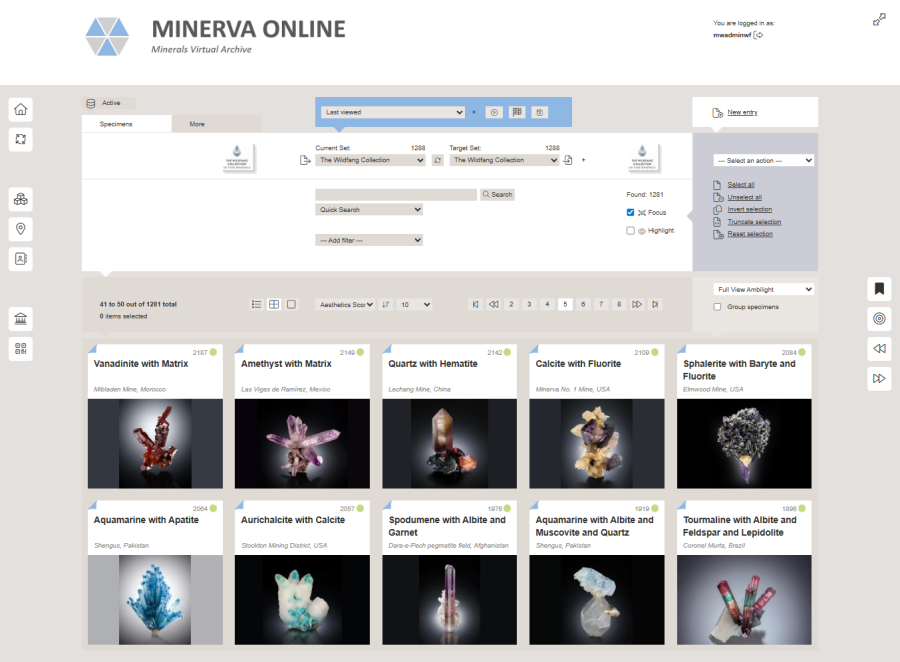
Internal collection database used for curatorial documentation and aesthetic evaluation.
 Druckversion
Sitemap
Druckversion
Sitemap
© The Wildfang Collection® 2026 Legal Notice / Privacy Policy please see Contact & Legal.
